
Why doing more gets you less
Take all that January effort and spread it out please

It’s 11:02 on Tuesday 13 January as I type this.
Rain is hammering against the back door, sounding even heavier than it looks as it slaps the concrete in the high-bricked alleyway beside us.
I managed to miss getting caught in it – up at 5:15, back by 10:45, after my first shift at Everlast+ in West Bridgford. Honestly, they were the fastest-moving business hours in uniform I’ve ever experienced.
I applied my autistic licence to the weight stacks in three of the five rooms, and within 90 minutes the place felt more like a lifter’s library – you could find exactly what you wanted just by walking left to right. Sandbag. Battle rope. Dumbbells. Kettlebells. Plates. We’ll see how long that lasts.
Then came two one-to-one sessions with people relatively new to personal training – let’s call them Annie and Hakim.
Their questions, and their genuine surprise at the answers, reminded me how many people come to coaching either for the first time (like Hakim) or after being quietly disappointed by it before (like Annie).
The assumption most fitness content quietly makes
Fitness & Thinking – as both a newsletter and a podcast – stands on the shoulders of giants. We borrow ideas, pressure-test them through experience, and hopefully brighten your day or interrupt an unhelpful pattern along the way.
But one thing I sometimes take for granted is this: people who pay for PT or read newsletters like this already know the how, the what, and the why of fitness.
I’m still learning new things about the body, about training, and about how to live inside one but I’m paid to be obsessed with this.
So, with no assumptions, and for your reading pleasure, today’s star witness is… me.
The advice everyone hears but few understand
There is one thing that will change your fitness – and probably your life – more than anything else:
Consistency.
Done.
End of newsletter.
Right?
Go on. Shoo.
…Still here?
Cheeky sod.
Here’s the problem: most people think they know what consistency means. They don’t.
Why “doing more” feels productive but rarely is
I actually think most of you are consistent.
Just not in the way you think.
Consistently going to bed late.
Consistently being “good” and then “starting again on Monday”.
Consistently in the gym every day for a week in January – and gone by February.
We’re taught, culturally, that effort equals progress and more is better.
But the tortoise and the hare is taught so widely for a reason. The hare loses. Every time.
Or, as armed physically elite people tend to say: slow is smooth, and smooth is fast.
All-or-nothing usually looks like a lot of something at the start… and not much of anything in the end.
What overload looks like in the real world
Hakim couldn’t believe it when I reduced his programme.
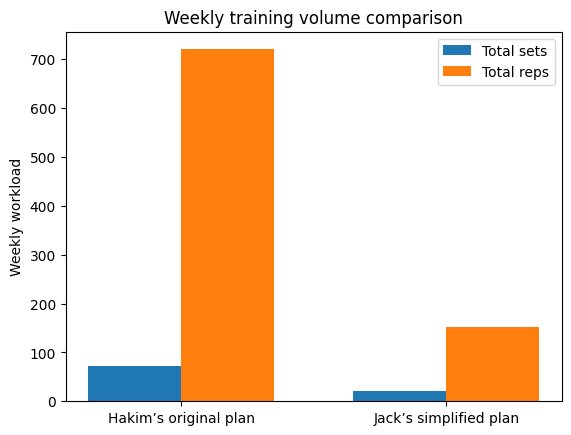
He told me sometimes he trained four times a week, eight exercises per muscle group, three sets of ten reps each. I cut it to two workouts, four or five exercises per session, two sets, sensible rep ranges rather than fixed numbers – and, in so doing, turned it into something he could repeat and improve upon next time he actually made it to the gym.
His original plan wasn’t lacking effort.
It was overloaded with volume.
Every movement was prescribed the same way. No prioritisation. No allowance for recovery. No room for how he actually feels on the day. Zero filtering for what mattered most.
And here’s the part people miss, including Hakim himself:
Hakim’s a dad. He runs multiple businesses.
How often do you think he realistically gets into the gym in a week?
Why more volume often produces worse results
Let’s be honest about probabilities.
Hakim wants to grow his arms but if he gets to the gym twice in a fortnight on his old plan, he trains his arms directly just once every two weeks. That’s far from optimal for building muscle – and, consequently, even worse for motivation.
On the revised plan, if he trains twice in a week, he trains them twice.
Same person. Less volume. Better outcome.
Minimum effective dose as a coaching principle
When I plan anyone’s training, I ask a very simple question:
What’s the least you can do to maintain what you have – and then grow what you want?
In medicine, this is called the minimum effective dose – the smallest amount of a stimulus needed to produce a meaningful effect.
Anything beyond that doesn’t necessarily help. It just increases side effects.
Training works the same way.
Fewer total sets.
Lower rep targets (because the weights are (more) challenging).
Clearer intent per session.
Effort directed where it actually matters: be a bit better than last time.
This isn’t about doing the bare minimum because you can’t be bothered. It’s about doing the right minimum so you can actually come back and do it again.
Because consistency doesn’t come from motivation; you don’t need motivation when you can feel and see that something is clearly working.
What sustainability actually looks like
Here’s the reality most programmes ignore.
Someone aiming to do 700 reps a week across four sessions and seeing no results is far more likely to quit than someone doing 150 reps across two sessions and getting bigger and stronger.
Minimum effective dose doesn’t look exciting on Instagram. It doesn’t sell well in January. It doesn’t make you feel like you’re “beasting yourself”.
But it does something far more useful: it keeps you showing up.
The uncomfortable conclusion
Doing more feels virtuous. Doing less feels like cheating.
But in fitness – and in life – the people who last are rarely the ones doing the most. They’re the ones doing what works, repeatedly, without burning themselves into the ground.
Not dramatic. Not sexy. Just effective.
So what’s actually more impressive?
A dad running multiple businesses, present with his kids, sleeves rolled up because the work worked – or someone grinding through their 500th rep, wrecked, resentful, and no longer sure why they’re training at all?
I think Hakim’s going to enjoy the next four weeks…
And that’s it from me!
Much love and I’ll see yas in the next one
J x